AnKing Step Deck Maintainer Handbook
Dashboard: AnKing Maintainer Dashboard
1.0 - Goal of the AnKing Step Deck Maintainer Handbook
- To orient and reorient new and existing maintainers on our protocols for updating and accepting changes for community suggestions and various projects that come up
- Remember: The changes you make will affect 100,000+ subscribers, and potentially many more in the future. As a maintainer, you must lead by example and follow these guidelines as much as possible!
- If there is anything in this document that needs further clarification or there is a question that is unanswered here, please send a message on Slack to Ahmed Khudair (@Ahmed7) (preferred and faster) or email anking.ahmedd@gmail.com
1.1 - Moderator teams:
| Role | Lead 1 | Lead 2 | Channel |
|---|---|---|---|
| The King | Nick |  |
|
| Lead moderator (suggestions) | Ahmed Khudair | Lead 2: Cameron Evans - Lead 3: Jacob Herstein | #anking-maintainers |
| New card suggestions | Jacob Herstein | Sameem Arif | #team-new-cards |
| Pixorize | Jacob King | David Westfall (pixorize) | #team-tagging-pixorize |
| Sketchy | Ahmed Khudair | Abdulla | #team-tagging-sketchy |
| Illustrations | Ahmed Afifi | Andy Revell | #image-replacement-illustrations |
| OME | Stan | Jacob King | #team-tagging-ome |
| Physeo | Rhett/Steve (physeo) | #team-tagging-physeo | |
| Boards & Beyond | #team-tagging-bnb | ||
| Bootcamp | Adam Raffoul (bootcamp) | Elias Borne (bootcamp) | #team-tagging-bootcamp |
| UWorld | Ethan | Jacob King | #team-step1 |
| #team-step2 | |||
| #team-step3 |
1.2 - What is a Maintainer?
- A maintainer is an individual responsible for the daily upkeep and “maintenance” of the AnKing step deck. They are granted maintainer privileges on AnkiHub to be able to accept and reject suggestions
1.3 - Roles & Expectations
- As a maintainer, there is no mandatory expectation in regards to time allotted. We are all busy medical students and we volunteer when we have the time. Below are the roles you will be fulfilling as a maintainer. Note: there is no minimum/maximum amount of hours once you have become a maintainer, however, being regular and active is always a positive
- Accepting and rejecting suggestions in-line with the AnKing Step Deck guideline public document
- Suggesting fixes to the deck (spelling, content additions, formatting, images, etc.)
- Weighing in on discussions when needed
1.4 - Eligibility Criteria
- If you have been selected as a maintainer, you have exhibited characteristics that align with our guidelines and values, these can be found below. This criterion is also used to screen new maintainers on AnkiHub
- Maintainer Eligibility Criteria
- 1-2 months of consistent activity on AnkiHub at a minimum (liking, daily commenting, helping out etc.)
- Mostly accepted suggestions compared to rejected (>60-70%)
- Shows initiative to learn/understand/work with formatting/suggestion/rationale guidelines of the AnKing deck (this document)
- Can contribute approximately minimum 1 hour a week to AnKing-related discussions/maintenance on AnkiHub
- Team player, respectful, helpful, and willing to learn, asks for help when needed
1.5 - Who are the Maintainers?
See below for a list of all maintainers, (sorted by alphabetical order)
- Maintainer Roster
- Abdulla J (@dollajas)
- Ahmed Khudair (@Ahmed7)
- Alex Caskey (@Alex)
- Andrew (@blueophthalmology)
- Andrew Mathias (@andrewmathias8)
- Andy Revell (@Andy)
- Cameron Evans (@Cameron)
- Cooper Larson (@KidCoLa)
- Dakota Morgan (@morgankota13)
- Dario (@GroupG_Strep93)
- Ethan Damron (@Dam_Doc)
- Gaurav Nigam (@gnigam)
- Ian Sellars (@IanTheBFG)
- Ryan Dib Nehme (@FrozenCherry)
- Jacob King
- Jacob Herstein (@herstein.jacob)
- Justin Williams (@jwill)
- Lars Andersen (@jollydolphin)
- Marina Levochkina (@God_Have_MRSA)
- Mike Bosh (@mb)
- Mitchel Nelson (@mitchelnelson)
- Musa Malik (@musamalik)
- Mohannad Khaled (@mohannadkh10)
- Nicholas Flint ()
- Sam Thomas-Pate (@sthopah)
- Sameem Arif (@sameem)
- Shmuel Sashitzky (@shmuelsash)
- Thomas Holmes (@thomas.holmes)
- Timothy Dillinger (@DillingerMed)
- Yara Elbardisi (@yelbardisi)
- Zarathustra (@zarathustra)
1.6 - Maintainer Onboarding Protocol
- If you have been reached out to in order to become a maintainer, you will be asked to do a couple of things:
- All maintainers should complete the following course that illustrates the principles of good flashcards. We will use these to guide all of our modifications of suggestions
- Read through the maintainer handbook document (the document you are reading right now)
- Read through the AnKing Step Deck public guidelines
- After this, you will be invited to the AnKing Maintainers slack chat where you can introduce yourself to the team! (don’t forget to tell us some things about yourself!)
- You will now enter a trial period for a week or two where you will try out being a maintainer. You can participate in discussions, suggest, comment per usual but without privileges to accept/reject. if all goes well, you will be granted maintainer privileges (you will be able to accept/reject) and be apart of the maintainer family!
1.7 - Maintainer Code of Conduct
- In general, we expect you to be professional at all times. Please treat this role as you would any other professional role (e.g. medical student, corporate job)
- Please treat everyone as you wish to be treated. Be respectful, courteous, and kind.
- Keep it civil; engage in constructive and polite discussions. Disagreements are okay, but personal attacks and insults are unacceptable
- Avoid offensive language, harassment, or any form of discrimination
- Help each other; foster a spirit of collaboration and support newcomers and make them feel welcome
- If any issue were to arise, please reach out to Ahmed Khudair (@Ahmed7) first
2.0 - Formatting Guidelines for Moderators
- As a maintainer/moderator, you are responsible for changes accepted/rejected by yourself. Therefore, you must abide by the guidelines found in the public guidelines and the ones outlined below
- As a maintainer, try your best to lead by example so others in the community can learn from you!
- Note: many of the guidelines here can be found on the public AnKing Step Deck guidelines
AnKing Step Deck Submission Guidelines
2.1 - Formatting Guidelines
- Some useful tips to keep in mind:
- Bolding and such should be used to draw your eyes. Our eyes go to bold first, then underline, then italics.
- It is best to tend to bold only the main subject and underline or italicize other important details.
- Italics can easily go unnoticed, particularly if you don’t use custom coloring.
2.2 - Capitalization and Italics
- Please maintain consistent capitalization. Example: I am a Deck Maintainer → should be → I am a deck maintainer. Capitals are only for names and the start of sentences
Capitalization and Italics in extra
- Please capitalize the first letter of each sentence in the extra section
- Please remove all italics from extra sections

 = No period at the end of sentence, no italics, start of sentence has a capital
 = Period at end of sentence, italics, no capital at start of sentence
In regards to demographics
- Per UTD, FA23, and the American Medical Association, we will keep capitalization when referring to White or Black populations. Online, there is a ton of variance however following the guidelines of the AMA, we have chosen to stick to capitalizing.
https://jamanetwork.com/journals/jama/fullarticle/2776936
2.3 - Dashes
Dashes in Extra
Whenever there are TWO or more sentences in the extra section. Add a dash at the start of the example, instead of:
- The heart is a pump
- The heart is approximately 300 grams
It should be:
-
- The heart is a pump
-
- The heart is approximately 300 grams


If there is only one sentence in the extra, dashes should not be added!
2.4 - Period formatting
- No cards in the deck end in periods, and most free sentences do not (unless it is a block of text explanation that requires multiple sentences in extra)

2.5 - Bolding, Underlining, and Italics
- Bolding and such should be used to draw your eyes. Our eyes go to bold first, then underline, then italics.
- It is best to tend to bold only the main subject and underline or italicize other important details.
- Italics can easily go unnoticed, particularly if you don’t use custom coloring.
- Use underlining sparingly!
2.6 - Mnemonic Formatting
If existing mnemonics are being shifted to our new formatting (see below) - we will bold the hint, and underline the appropriate letter of the mnemonic
Mnemonic sentence formatting must follow: “may be remembered with the mnemonic”

Please user the wrapper meta-addon to apply the “mnemonics” styling to the 1by1 card so they can be left-justified
Wrapper meta add-on: https://ankiweb.net/shared/info/396502676
2.7 - Cloze deletions
- For suggestions relating to an increase or decrease (e.g. ‘diabetes {{c1::increases}} glucose’) the preference would be for a cloze hint of ‘increases/decreases’, in that order, like so: ‘diabetes {{c1::increases::increases/decreases}} glucose}}’. This is unless the potential answers are obvious.
2.8 - Disease Name Formatting
When listing the full name of the disease and the abbreviation in parenthesis (dz), bold the actual disease name and unbold the (abbreviation) as shown below

2.9 - Image Reveals
- Where a question presents an image prior to pressing ‘show answer’:
- If the answer is text, it should be revealed above the image.
- If the answer is an image, it should be revealed below the image.
- Where a question presents an image after pressing ‘show answer’:
- If the answer is text, the image should be in extra, rather than being clozed.
- If the answer is an image, it should be clozed as usual.
2.10 - One-By-One card guidelines
The general rules for one-by-one are as follows:
- The cards need to be able to be recalled in order - this means that there needs to be a mnemonic or a sequence of treatment
- The 5 P’s of pheochromocytoma can NOT be one-by-one because they all start with P and it will be impossible to do “ordered recall”
- One by one notes should not be done for cards that have 2-3 clozes, unless they are mnemonics
- If you want further guidance on how to format these, please reach out to Ahmed Khudair (Ahmed7)
Tables & Algorithims
2.11 - Table formatting
Please see 📚 AnKing Step Deck Submission Guidelines
2.12 - Algorithms
For algorithms, see the submission guideline document: 📚 AnKing Step Deck Submission Guidelines
Content & Images
This is covered here as well: 📚 AnKing Step Deck Submission Guidelines
2.13 - Major content changes
- For any change(s) that significantly alter the structure of a card or how the card is answered, a brief explanation must be added to the top of the extra section. Include source(s) if applicable.
- At the end of the explanation, note the current date in the following format “(M/YYYY)”
- Example: “This card previously stated __, however, AMBOSS confirms ___. (May 2023)”
- Major change explanations should be removed/deleted from the extra section after 1 calendar year. Pertinent info from the explanation should be incorporated into the extra section in the typical format.
2.14 - Self-Made Images
- Please add “The AnKing LLC” with the copyright logo either on the bottom left or bottom right of the picture if you are willing to hand over the rights to the image you created over to us
- Please try your best to use the font “Arial Greek” in line with most other images in the deck
- You can alternatively place the image under public domain, you can upload it to a site such as Wikimedia Commons and do it that way
- Below is an example of how the copyright and text should look like

2.15 - Image Additions
Please check the submission guideline document for image addition information: 📚 AnKing Step Deck Submission Guidelines
- We encourage you to add images that support learning and enhance a user’s understanding and retention!
- Video tutorials for Wikimedia Common images, journal images, and radiology assistant images can be found in the Slack Canvas
Checklist for images
-
The image is under 1000px in width when resized in Anki (original file should not exceed 4000-5000px)
-
The image is under 1 mb in file size (the lower the better)
-
The image has the illustrator’s name (or a proper photo credit if non-applicable)
-
The image has the AnkiHub, LLC copyright symbol (or creative commons license)
-
The image is my own work (if not or you used elements from the web, make sure it is CC BY, CC BY-SA. It cannot be CC NC)
-
The title is in proper capitalization (This is my illustration
) vs. (This Is My Illustration  )
) -
No generative AI has been used in the creation of the image
No generative AI images should be accepted into the deck. The same rule applies to illustrations.
2.16 Usage of Slashes and Spacing
Correct: Lymphoma / leukemia
Incorrect: Lymphoma/leukemia
Correct: < 126
Incorrect: <126
2.17 Versus & AKA Formatting
Correct: vs.
Incorrect: Vs.
Incorrect: VS.
Incorrect: Versus
Correct: AKA
Incorrect: Aka
Incorrect: aka
2.18 Photo credit format for two images
Photo credit: AnKing et al., CC BY 4.0, via USMLE (1st image); AnkiHub et al., CC BY 4.0, via NBME (2nd image)
2.19 Video Link Format
- Watch ‘Video title’, Author, via Website (Time)
- Make sure to include ’ ’ around the title of the video
- The title can be shortened (if the title is iPhone 14pro review apple tech.mp4", you can change it to ‘IPhone 14 Pro Review’)
Example:
- Watch ‘Kung Fu Panda’, Disney, via YouTube (0:57)
3.0 - Content Guidelines for Moderators
Important to Note
3 upvotes are needed in order to push at a minimum.
In certain cases 2 upvotes if it is a minor change.
1 downvote will need further discussion as to why
2 or more downvotes generally means your initial suggestion needs more revision
 Also important, please DO NOT accept any new note suggestions. Only @herstein.jacob is authorized to do so currently
3.1 - Personal Suggestions
- If you have personal suggestions (new content, heavy modifications) that you want the other maintainers to see, please submit them as regular suggestions so we can weigh in on AnkiHub
- If you are doing maintenance work per other projects below (small tags, line breaks, etc.), feel free to upload suggestions as a maintainer
3.2 - Suggestion with No Sources
- If a suggestion is made without a source, or just says “UWorld” as the rationale, feel free to reject and request more specific documentation (feel free to use the text below for source rejections)
Please resubmit with an acceptable source. Please review suggestion guidelines, specifically rule #1: Notion
-
Our general hierarchy for supporting documentation is as follows:
-
(regarding AMBOSS = UWorld, please refer to the “things to note” section for more information
- Society guidelines (AAFP, USPSTF, etc.) > AMBOSS = UWorld >> FA = B&B step 2 CK
-
If a UWorld question is listed as supporting documentation, we require specific QID as well as text to be copied into the rationale
-
For AMBOSS, we request the specific page unless it can be easily searched
-
If there is a discrepancy between AMBOSS and UWorld, the UWorld information will be added to the extra to highlight these differences
-
Please check the Public Maintainer Guidelines Document for more information on accepted/rejected sources as well as rationale
Suggestion Rejection Text
-
Source
Please resubmit with an acceptable source. Please review suggestion guidelines, specifically rule #1: 📚 AnKing Step Deck Submission Guidelines
-
Rationale
Please resubmit with an acceptable rationale. Please review suggestion guidelines, specifically rule #2: 📚 AnKing Step Deck Submission Guidelines
-
UWorld
Please resubmit with a proper rationale on why this QID tag should be added. Refer to rule #8 of the maintainer guidelines. Link: 📚 AnKing Step Deck Submission Guidelines
-
Add it yourself
You can add this yourself by right-clicking on the card → go to AnkiHub protect fields → select the field you want to protect → add it yourself and it won’t be overwritten
-
Image
Please resubmit with acceptable image formatting guidelines. Please review suggestion guidelines, specifically rule #3: 📚 AnKing Step Deck Submission Guidelines
-
Empty Card
On Anki, go to the top left and find tools, then click on empty cards, then press delete
-
3.3 - Duplicates
- You will get suggestions for dupes - as of now @Ahmed Khudair is handling most of them, however if you would like to learn how to properly consolidate multiple cards together, please check the video tutorial out in the Slack Canvas (top right button in the anking maintainers slack channel).
For a duplicate to pass slack voting, it will need on average around 6 upvotes with 0 downvotes (downvotes basically mean someone thinks it is into a dupe or wants the other one instead of the one with the most votes).
Accepted scenarios
- 6 or more upvotes + 0 or 1 downvotes
- 7 or more upvotes + 2 downvotes
- 8 or more upvotes + 3 downvotes
This can obviously vary based on scenario but in general 6+ is recommended
New workflow as of Feb 22 2024
The new workflow will be
- Two notes are found that are dupes of each other
- It goes through slack voting
- It passes the voting → everything from the card we DONT want to keep gets moved to the card we WANT to keep (pixorize, sketchy, extra, additional resources, images, tags, everything etc.)
- A !DELETE tag gets added to the card we are NOT keeping as well as this text below
Duplicate card! If you have already unsuspended this card which is now marked for deletion, please use nid:__________ as replacement. If you have not unsuspended this card, you can simply delete 
- After this. merge both cards with this rationale “dupe consolidation - delete the one with the !DELETE tag. To view which one that is, click on the bulk id # and “show closed” suggestions”
- After everything has been merged, sync with AnkiHub → go to the card we want to delete → suggest card deletion (be extra sure its the card we want to DELETE not keep → accept the suggestion (if you want to be extra careful, have someone else look over it and give you the okay)
3.4 - Spelling
- Fix any spelling mistakes you see
- If there is discrepancy regarding the wording used (e.g. hemianopia vs hemianopsia). Please send this to the Slack chat so we can vote on which to use. Regardless, all words must be changed to the new format used after the decision
3.5 - Important Things to Note
- Any significant change or mnemonic change will need approval from at least one of the following people: Abdulla (dollajas), Nick (AnKing), or Ahmed (@Ahmed7 ) (refer below to what needs approval) and all of these changes must reach a minimum of 3 upvotes (please leave some time for the majority of the maintainers to weigh in)
- Team votes are highly encouraged in all regards, most content suggestions will need to be decided upon as a team, please do not push any significant content change without team discussion first
- UWorld = AMBOSS, if there is a discrepancy, research must be done and the team will vote on the next best step. If one resource is picked over the other, the other resources’ discrepancy must be stated in the extras
- If you have an issue with a certain change that was merged, it is your responsibility to bring it up to the team. HOWEVER, please do communicate with the user in private first, after your discussion, feel free to bring it up to the maintainer chat and a vote will then be conducted and the decision to revert or not will follow as a result of the team vote.
3.6 - Examples of suggestions that DO NOT need maintainer approval (does not need 3 likes)
- Changing Pseudomonas to Pseudomonas
- Changing DCM to dilated cardiomyopathy (DCM)
- General punctuation, grammar, spelling, and formatting (large changes, such as changing entire sentences or closes, will need to be approved)
a. Adding a line break to the extra section where it really needed it (too much text stuck together)
b. Adding dashes/removing dashes if necessary
c. adding in Oxford commas, commas, removing semi-colons in text clozes that are not necessary
d. removing excessive underlining/bolding that detracts from the purpose of the bold/underlining
e. Adding bolding/underlining/italics to a card that previously had nothing (please use your judgement, don’t add too much, only what is necessary) - Adding relevant information (images or text) to connect concepts from another card already in the deck
- Changing the sizes of images to a relevant size if appropriate, fixing photo credits (adding correct hyperlinks etc.)
- Adding a minor hint that is really needed/would greatly benefit the card in question, if its something you are unsure about or would make the card way too easy, again reference the chat to see if maintainers are in agreement.
3.7 - Example of suggestions that DO need maintainer approval (6*** likes or more - if it is your own suggestion, your upvote does not count)
**1. *New clozes, changing of words inside clozes, adding or removing words from clozes, adding/removing new text to the text field (Updated July 10th, 2025 - Changes to clozes or the text field require at least 6 likes or more. The more likes, the better. The more in consensus we are within the group regarding a change, the more sure we can be that the other 100,000 learners will also benefit from the change)
- Rewording of entire cards or a section of extra
- Formatting in which if another user saw the card in 3 months, would not understand solely due to the formatting being different
- Any addition of new content from AMBOSS/UWorld etc.
- Any removal of text for any reason, or removal of a good amount of extra (removing redundant text, things that are 100% unnecessary to have in the extra is okay, if you are not sure please double-check with the chat)
3.8 - Changing Content & 1by1’s
- When deciding to change important things such as guidelines etc. All relevant board-related resources, especially questions, must be checked to see if this is a net benefit. If UWorld, NBME, or AMBOSS are not testing the specific change, even if it is updated, then it will be added to extra without changing the text. Priority goes to doing well on boards, not necessarily real-life.
- One-by-one cards must receive 6 maintainer upvotes before being pushed at a minimum. Voting for these cards must be open for several days. If deciding to make a new one-by-one card, then keep the separate cards alone. (example: if a maintainer chooses to make a new card for the A-BEAM cardioselective beta blocker mnemonic, the separate cards must be kept due to personal preferences of the subscribers)
- If there is an issue with a certain card that can not reach a proper consensus, please tag Ahmed Khudair (@Ahmed7) . If still no decision can be made, then please tag Nick
3.9 - Disclaimer
- REMEMBER: Your changes affect 45,000+ users, a change you think is a good idea might not be, therefore having maintainer consensus is something highly encouraged and a standard you should stick to.
- In general: 3 upvotes are needed in order to push at a minimum, in certain cases 2 if it is minor. 1 downvote will need further discussion as to why, 2+ downvotes generally means your initial suggestion needs more revision
3.10 - Slack Canvas
- Please make sure to utilize the Slack Canvas (videos, links, tutorials, resources are all available for you to use!)
- You can find it by navigating to the anking maintainers chat on Slack and clicking the canvas button in the top right
Slack Canvas Images


4.0 - New card suggestions
New cards suggestion algorithm
-
How to add new notes and adjust their date created to fit better in with other old notes
Get this addon: https://ankiweb.net/shared/info/806857685
Watch this video: How to adjust note IDs when adding new cards · CleanShot Cloud
5.0 - Projects
We actively need help with all of these, please DM @Abdulla Jastaniah on Slack if you are interested in spearheading this and we can discuss the details
5.1 - UWorld Tables Project (Ongoing)
For UWorld tables and algorithm making, check out the submission guidelines document here: 📚 AnKing Step Deck Submission Guidelines
6.0 - Unified Tagging System
6.1 - Unified Tagging System
*Note, Andy Revell has completed the unified tagging system and we are waiting to roll it out.


6.2 - Purpose
Summary
- A common tagging system under which all cards are organized.
- Functions like a ****table of contents where you can find anything about a disease or topic broken down in a systematic way. Similar to reading about topics on AMBOSS or UpToDate
- Each card is tagged under Step 1, Step 2, Step 3, etc., however, this tagging system unifies all topics so that one can see all related cards under a given topic
- This is different from merely searching keywords in Anki or algorithmically finding related cards through word ontology.
- You can see how testable information is related to each other and organized with other subjects
- It helps solve the problem if one has suspended step 1 cards but they are weaker in the foundations on a certain subject, they can find the relevant cards to quickly get up to speed. For example, just because a card is only tagged in Step 1 does not always mean it is completely irrelevant. Sometimes answer choices may be written in a way that you still need to know Step 1 information (i.e. “what’s the best next step?” Answer choice lists the drug’s mechanism of action instead of the drug name themselves).
- What may be tagged under Step 1 vs 2 vs 3 are always a moving target to some extent, this unified tagging system transcends and guards against those changes
- The main principle of the unified tagging system focuses on taxonomy (the practice and science of categorization or classification) and less so on board exams
- But it still lends credence to how information is organized with respect to board exams. Step 1 focuses on basic science information, step 2 on application and management, and step 3 on the practice of medicine. Thus the tagging system still
- The final purpose of this tagging system is to help us curate new cards.
- ****we need to be able to see what information is missing — not just determine if it’s high yield and is part of our approved comprehensive sources. Note that the original philosophy of the Zanki deck was that it was very comprehensive — i.e. it contained every piece of information from First Aid no matter how low yield. The problem now is that there is no comprehensive First Aid-like resource for Step 2.
- Finding missing info is a much bigger problem to solve than editing current cards that exist. Now we can see which diseases don’t have any information on its management or diagnosis, or if there are too many cards in one particular subject.
Organization
- The structure of the tagging is largely built off of First Aid’s structure
- It begins with biochemistry, immunology, etc.
- However, there are major differences
- the reproduction section of FA is broken apart to reflect more on how medicine is actually practiced and medical specialties are organized.
- In other words, there is now an OBGYN section
- The classic reproductive disorders (e.g. the disorders of sexual development) and pediatric developmental disorders are contained within its own section. This comes immediately after the endocrine section, of which many of these topics are directly related to the endocrinology, and managed by endocrinologists.
- The genitourinary disorders that fell under the old Reproduction section now fall under the genitourinary section. This contains both nephrology (the old renal section) and urology, of which urologists sometimes manage men’s sexual health disorders, like testicular torsion, and is distinct from OBGYN. Thus, what was contained in the old Reproduction section may also appear in urology because that is how medicine itself is practiced and organized.
- Ophthalmology is its own major section and is broken from Neurology. To consider making ENT its own section — it is currently its own section under respiratory.
- Pharmacology of each system is now under its own section rather than having all the drugs scattered across the systems. This is because many drugs are related to multiple systems and it is much easier to have a single drug section. Also, the random “Autonomic Drug” section contained within the old Pharmacology section now falls under cardiovascular. It was a weird editorial decision by First Aid that a whole section of drugs was contained within just the Pharmacology section, and although there are reasons for it (what system does the autonomic drugs full under? Cardiology? Neurology?), it was still an oddity from their typical system of drugs related to a particular system are in that system. They could make a claim that the autonomic drugs falls under multiple systems, thus they put it generally under pharmacology. However, many drugs fall under multiple systems. Under this tagging system, things are much more logically organized.
- Surgery section. The practice of medicine can largely be divided into medicine vs surgery, yet First Aid has never had a section dedicated to even basic sciences principles of surgery in its 30+ year history. Nothing on wound care, nothing on post-op fever. Although many topics are scattered throughout the entire text (collagen synthesis in scar formation, or the basic biology of a fever), this information is not organized in a way that is relevant to further practicing physicians. Fortunately, there is already a surgery section in the step 2 tags. Furthermore, each system has a section dedicated to procedures and trauma.
- Toxicology section within Pharmacology. This section is largely expanded from First Aid, and contains information largely relevant for Step 2. Any cards that I (Andy) saw relevant to toxicology (drug reaction, antidotes, bites, stings, etc.), I tried adding to this section. This section is largely still under work.
Disease organization
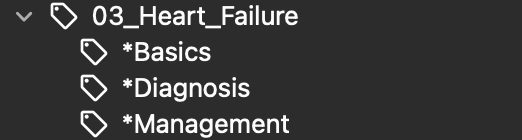
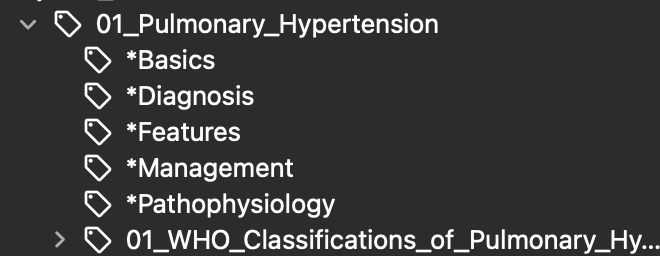
- Each disease has 5 parts: *Basics, *Pathophysiology, *Features, *Diagnosis, *Management
- *Basics: contains the truly basic information. It has the cards on disease definitions or other really basic information that someone with a bachelors degree can jump in and start understanding these cards. It may have information on epidemiology (e.g. disease X is more common in young adult men).
- *Pathophysiology: contains the cards about the pathophysiology of a disease (e.g. X receptor is up regulated causing Y electrolyte abnormalities with Z symptoms). The distinction between *Basics and *Pathophysiology is definitely the most blurred among these topics (also, Andy defaulted to putting most cards into *Basic on initial pass if it did not distinctly contain management or diagnosis information). Since many cards have different “Created Dates” and there isn’t a best way to order the cards currently, the focus of the *Basics section was to flag to someone to start reading there and not have the first card be some complex pathophysiology about a disease when you don’t even know what it is.
- *Features: contains the cards about what a disease may look like. It contains many of the cards with the clinical vignettes (”what is the diagnosis in a patient presenting with X, Y, and Z symptoms). This section’s main purpose is to help someone quickly recognize the pattern of a disease in a question stem. These are the features you should be looking for to come to a diagnosis
- *Diagnosis: contains the cards about how a disease is diagnosed. It contains the quantitative tests, not just the physical exam findings which may be in *Features. Note that some diseases (e.g. Parkinsons or Carpal Tunnel) are clinical diagnoses from the *Features section, but to make the diagnoses, you still typically run other tests (imaging, EMG, labs, etc.). If a card says that X disease is a clinical diagnosis, then that card falls under *Diagnosis. But what that disease looks like falls under *Features.
- *Management: contains the cards about how a disease is managed. This is called “management” and not necessarily “Treatment” because treatment is a sub-division of management. Intubation may not necessarily treat a disease, but it would definitely be the next best step to manage that disease given a clinical scenario. If the next best step pertains to how a disease is diagnosed (e.g. X test yields Y result, but you still need to perform Z test), then it falls under the *Diagnosis section (like the thyroid nodule workup). Of course, this can be still regarded as “management” of a presenting pathology, so there can definitely be a debate on which category it falls under.
- Note that some cards have information from multiple sections (e.g. a card tests information on how you would make a diagnosis and what’s the best next step). If this happens, the order of preference is Management > Diagnosis > Features > Pathophysiology > Basics. If information is particularly important/high yield, then it may be put under both sections. If one section has no cards (e.g. there is only one card containing diagnostic info, it also has management info, but there are multiple management cards too), then that card would be tagged under both sections. The point is that someone who is looking information up about a topic can quickly go to the *Diagnosis section if they don’t know how something is diagnosed, yet they may still know how to manage the disease. Now they don’t have to search all the cards under management.
- Final note: it is our job as editors to figure out what section a note should fall under based on the language of the note. Some are definitely up for debate.
Drug Organization
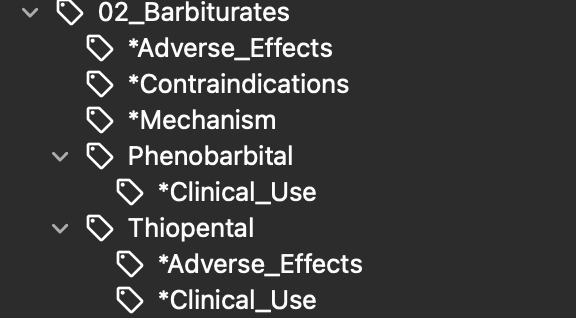
- Each drug/molecule is organized with 4 parts: *Mechanism, *Clinical Use, *Adverse Reactions, *Contraindications
- *Mechanism: contains information on how the drug works
- *Clinical use: contains information on what the drug may be used for
- *Adverse reactions: contains information on any adverse reactions, side effects, etc. may happen
- *Contraindications: contains any contraindication (e.g. don’t use another drug with it, or don’t use this drug in X scenario). There are definitely cards with overlap in *Adverse Reactions and *Contraindications, but the point of *Contraindications is to flag to someone “hey, not only is there a bad reaction, absolutely do not give this drug here because your medical license may be on the line, so you should probably pay attention to these cards here first”).
- If a card contains information from multiple sections, the order of preference is *Contraindications = *Clinical Use >*Adverse Reactions > *Mechanism