Lesson 3 - What is Anki…and WHY should I use it?
Along with learning how to use this deck well, as we’ll describe in this course, it is essential to learn how to use Anki well. This course assumes you already know the basics of Anki, however:
if you do NOT, you can continue with this lesson.
If you already know the basics of Anki, you can skip this section.
 What is Anki?
Anki is a free, open-source flashcard app that allows you to create and study flashcards. It implements two of the most effective learning techniques, spaced repetition and active recall. Created by Damien Elmes in 2006, with a wide team of contributors and add-on creators, and a global community of users, Anki is a powerful tool that can be used to learn & memorize anything, from languages to medicine.
Did you know?
The word ‘Anki’ is derived from the Japanese word for memorization (暗記)

 The science behind memory, spaced repetition, & active recall
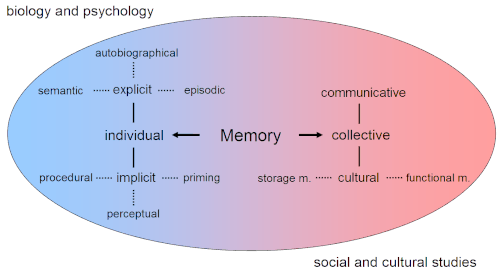
Memory is a complex process in which the mind encodes, retains, and retrieves. Memory can be in several forms:
Short-term memory (sometimes referred to as working memory)
- The ability to hold information in the mind for a short period of time, usually seconds to a minute, without the need to rehearse it
Long-term memory (divided into explicit and implicit memory)
- The ability to hold information in the mind for a long period of time, from minutes to years, or even an entire lifetime
Explicit memory (AKA declarative memory), which itself comes in 2 forms (episodic and semantic)
-
Episodic memory → The ability to recall facts that are tied to a specific context what, when, where, such as a birthday party. It is more associated with personal memory
-
Semantic memory → The ability to recall facts that are context-independent, such as ‘Arizona is a state in the United States’
Implicit memory (non-declarative memory)
- Procedural memory (a type of implicit memory) → Best described as the ability to perform a task without conscious awareness of the process, with examples such as riding a bike or playing the piano
Practically, something you saw 10 seconds ago is much easier to recall, but something you saw 3 months ago is much more difficult to recall. Hence, the concept of spaced repetition comes from.
Hermann Ebbinghaus, a German psychologist, was the first to experiment on and study memory. In 1885, he published his findings in a book called “Memory: A Contribution to Experimental Psychology”
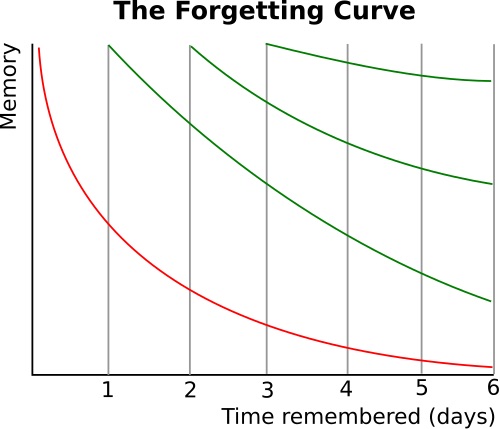
Below is a typical example of the forgetting curve, which shows how memory decays over time when not reinforced or repeated

Spaced repetition, in its simplest form, is the act of repeating something at regular intervals. In fact, you have most likely already done this in your life when studying for exams and tests.
Example
You are studying for a test and you want to memorize a list of 100 words. You start by memorizing the first 10 words, then the next 10, and so on. In 3 days, you repeat the first 10 words, 5 days after that, you repeat it again. In 2 weeks, you repeat it again.
What changes is the interval over time. Each time you repeat the words, the time between each repetition needed to keep it in your memory decreases, as illustrated in the image below
Although spaced repetition is a powerful technique, it must be accompanied by active recall. Reading your notes on a topic in 3 days, is not as effective as actively recalling the information from memory. Although this requires much more mental effort, it is much more effective for long-term retention
Active recall is the act of retrieving information from memory. Interestingly enough, this process was documented by Francis Bacon in 1620, where he stated:
“Hence if you read a piece of text through twenty times, you will not learn it by heart so easily as if you read it ten times while attempting to recite it from time to time and consulting the text when your memory fails." - Francis Bacon
In essence, testing yourself on information from memory is much more effective than passively reading the material over and over again. This is precisely what Anki excels at, not only combining active recall, but spacing out the repetitions for you using some of the most powerful spaced repetition algorithms in the world, SM-2 and FSRS
 Studies and findings from the literature
Research on the topics of memory, Anki, active recall, and spaced repetition has been conducted throughout the years for many years.
If you’d like to learn more, see supplemental section D for a deeper dive into the science: 🧪 Supplemental D - Research & Science on Memory, Spaced Repetition, & Active Recall
 Next topic: Lesson 4 - Get everything set up and installed in this lesson
 Previous topic: Lesson 2 - What is the AnKing Step Deck?
Some resources to help you learn Anki
- Some resources to help you learn Anki:
- Anki Mastery Course - up to date, comprehensive online course with a Butler add-on that automatically configures recommended settings and installs 50+ useful add-ons
- How to make high-quality flashcards with our free mini-course
- AnKing Youtube playlists
- Anki documentation
